ESG: Why It’s Not Just About the Environment
When ESG is discussed, the public conversation often ends up revolving around just one axis: the environment. This is understandable. Climate change, energy, emissions, and the industrial transition are visible and measurable issues, and corporate communication tends to prioritize what lends itself best to charts and catchy claims.
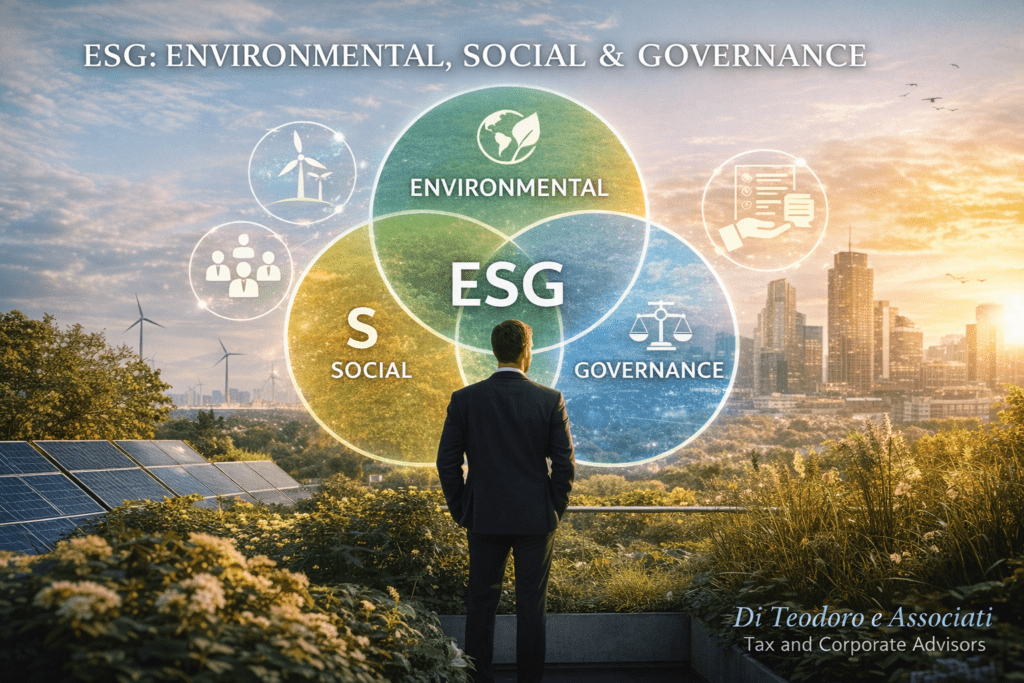
Yet ESG is an acronym that encompasses three dimensions: Environmental, Social, and Governance. Reducing it to “environmentalism” is an oversimplification that, over time, has produced two consequences: on the one hand, a distorted idea of what companies are actually doing; on the other, growing distrust toward a concept perceived as vague or instrumental.
A more useful way to look at ESG is to consider it for what it is: a management framework that helps assess impacts, risks, and the quality of business decisions. And within this framework, people are not an ancillary element: they sit at the heart of the “S” and, indirectly, also of the “E.”
What Does ESG Mean Today?
The question “what does ESG mean?” is often asked as if the acronym were a static definition. In reality, ESG works more like a shared language: it is used to describe how an organization manages issues that affect:
- operational continuity and risks (physical, regulatory, reputational, and supply-chain risks)
- the quality of work and human capital
- the trust of investors, customers, and communities
- transparency, controls, and decision-making accountability
In other words, ESG is not a “green” fad. It is a way to make certain decisions—ones that until a few years ago sat outside traditional metrics—more transparent and comparable.
The Limitations of a “Green-Only” Reading
When ESG is read as synonymous with the environment, two essential pieces are lost.
First, it ignores that many corporate problems do not originate from an environmental KPI, but from social and governance factors: workplace accidents, turnover, supply-chain disputes, unfair commercial practices, privacy breaches, distorted internal incentives, and inadequate controls.
Second, it fuels a communication paradox. The more the narrative is flattened into “how green we are,” the greater the risk of misunderstandings and accusations of window dressing. Not because the environment doesn’t matter, but because a sustainable company cannot be proven solely by an emissions figure if protections at work, fairness in the supply chain, or credible governance rules are missing.
The “S” for Social: When ESG Is About People
If we want to show that ESG puts people at the center, the most explicit letter is the S. This is where policies, procedures, and outcomes that affect real people come in: employees, contractors, suppliers, customers, and communities.
Work, Health and Safety
The social dimension includes issues that affect the day-to-day reality and dignity of work:
- health and safety (prevention, training, near-miss reporting, contractor management)
- work organization and workload (shifts, work-related stress, work–life balance)
- contractual stability and the quality of employment
- career development pathways and continuous training
These may seem like “HR” topics, but they have direct effects on productivity, quality, accidents, disputes, and reputation. Above all, they are the litmus test of whether a company views people as a cost or as an asset.
Inclusion, Equal Opportunities, Fairness
The issue is not just “doing diversity.” It is more concrete: preventing processes and decisions from creating exclusion, inequality, and a loss of skills.
Typical examples:
- fair access to career progression and pay
- measures against discrimination and harassment
- leadership and managerial culture (not just written policies)
- workforce composition and generational turnover, where relevant
Here, a useful ESG approach is less narrative and more measurable: indicators, audits, feedback mechanisms, grievance handling, and root-cause analysis.
Communities, Territory, Value Chain
Social ESG does not stop at the company’s boundaries. It includes impacts on the local area and across the supply chain:
- responsible procurement practices
- working conditions and rights in the supply chain
- impacts on local communities (noise, traffic, resource use, industrial relations)
- contributions to services and infrastructure, where relevant
In many companies, this is precisely the critical point: the “S” is where the contradictions between what a company declares and what it tolerates along its supplier chain become visible.
Customers, Users and Data
An often underestimated part of the “S” concerns the relationship with customers:
- product safety and quality
- commercial transparency
- accessibility and inclusion of services
- data protection and cybersecurity (in relation to people’s rights)
Here too, people are at the center: the impact is not abstract, but tangible.
The “G” for Governance: Rules, Accountability, and Trust
If the “S” highlights people, the “G” shows whether the organization is able to sustain its commitments over time. Governance does not mean bureaucracy: it means who decides, with what information, with what controls, and with what incentives.
Decision-Making Structure and Accountability
Credible governance is evident when:
- roles and responsibilities are clear (including across different functions)
- control processes are independent and not merely formalities
- critical decisions are traceable and justified
- goals and incentives do not reward only the short term
Many corporate crises stem not from a lack of policies, but from how decisions are made under pressure.
Ethics, Compliance, Anti-Corruption
These are “classic” topics, but they are not marginal:
- codes of ethics that are applied, not just published
- effective reporting channels (and protection for whistleblowers)
- conflict-of-interest management
- controls over intermediaries and partners
Here ESG becomes a matter of trust and avoided costs: disputes, sanctions, loss of customers, exclusion from tenders or supply chains.
Transparency and Data Quality
A key factor that distinguishes substantive ESG from cosmetic ESG is the quality of information:
- consistent, verifiable data
- declared calculation methods
- clear boundaries (what is included and what isn’t)
- updates and revisions when scopes and processes change
Information governance is an integral part of corporate governance.
The Environment Is Not Separate from People
Saying that ESG is not only about the environment does not mean downplaying the environment. It means placing it in context. The “E” covers emissions, energy, water, waste, biodiversity, and pollutants. But these variables affect:
- public health and living conditions
- people’s safety (extreme events, water stress, heat)
- the availability and cost of raw materials
- the stability of territories and infrastructure
In a comprehensive reading, the environment also becomes a social issue: air quality, risks to workers, impacts on communities, and a just transition. This is where ESG stops being a label and becomes a useful lens again.
ESG as Risk and Performance Management
ESG is often set against economic performance, as if they were separate planes. But in practice, many ESG choices are management choices:
- preventing operational and legal risks
- protecting human capital and skills
- stabilizing the supply chain and sourcing
- improving access to markets and customers (who demand standards and data)
The key element is materiality: focusing on what is relevant to the business model and stakeholders, avoiding generic checklists.
How to Build a People-Centered ESG Strategy
If the goal is to communicate—and practice—an ESG approach that spans multiple areas and puts people at the center, the operational sequence matters.
1. Define material topics with a method
- map relevant stakeholders (internal and external)
- listen to the evidence: data, audits, complaints, surveys, incidents, turnover
- identify priorities: where impacts and risks are greatest
2. Set measurable goals and KPIs
There is no need to multiply indicators. What matters is choosing the ones that drive decisions:
- safety: injury rate, training, near-miss reporting, contractors
- people: retention, engagement, training hours, internal mobility
- supply chain: audits, non-compliance, remediation timelines
- ethics: reports handled, response times, third-party controls
3. Build credible internal governance
- clear roles across HR, operations, compliance, procurement, sustainability
- committees and decision flows with real accountability
- integration into processes: procurement, product development, risk management
4. Manage data and traceability
- define internal standards for data collection
- avoid “one-off numbers” that are useful only for reporting
- provide for controls and reviews
5. Communicate without oversimplifying
Effective ESG communication:
- describes choices and trade-offs
- acknowledges shortcomings and improvement plans
- avoids slogans and uses understandable metrics
Practical indicators to avoid reducing ESG to a label
To make the idea that ESG is not just about ecology more concrete, it can be useful to present examples of indicators for each letter.
E (Environmental)
- energy consumption and intensity
- emissions and reductions per unit of product/service
- water management and water risks
- waste, recycling, hazardous substances (if relevant)
S (social)
- health and safety: frequency and severity, training, contractors
- health and safety: fequency and severity, training, contractors
- fairness: pay gaps, access to roles, career paths
- supply chain: audits, non-compliance, remediation timelines
G (Governance)
- the independence and expertise of oversight bodies
- anti-corruption and conflicts of interest: controls and cases handled
- reporting channels: usage, handling, protection
- data quality and internal controls over reporting
They are “cold” indicators, but they say a lot. And above all, they prevent ESG from becoming an indistinct catch-all.
In conclusion
ESG is not an elegant synonym for environmentalism. It is a scope of responsibility that includes the environment, people, and rules. If you want to understand where a company is heading, measuring its environmental footprint is not enough: you also need to look at how it treats work, how it manages its supply chain, how it makes decisions, how it controls itself, and how it is held accountable.
From this perspective, ESG does not shift attention away from people: it brings them back to the center, with tools that are more concrete than the public debate often suggests.
Are ESG and sustainability the same thing?
Not exactly. Sustainability is a broad concept; ESG is a structured way to assess and manage environmental, social, and governance topics through indicators and processes.
Why do people talk so much about the “E” and so little about the “S” and “G”?
Because the environmental dimension is more visible and easier to communicate. But many corporate risks and impacts are social and governance-related, and they directly affect trust.
What examples fall under the “S” in ESG?
Health and safety, training, job quality, inclusion, rights in the supply chain, and the protection of customers and data.
What does the “G” in ESG include?
Accountability and controls, ethics, anti-corruption, conflict-of-interest management, transparency, and the quality of reporting.
How can you avoid ESG becoming just marketing?
By defining material topics, measurable goals, clear governance, and verifiable data; and by communicating choices and results without slogans.
Daniele Di Teodoro
managing partner