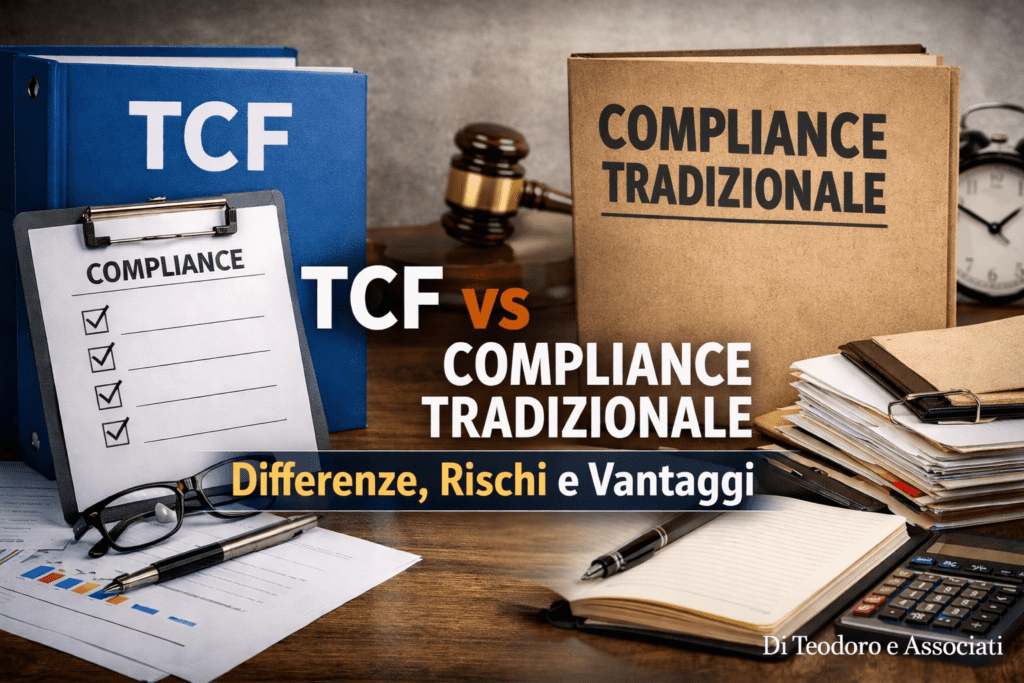
TCF vs Traditional Compliance: Differences, Risks and Benefits
Tax Control Framework vs Traditional Compliance Models
Many companies believe they are “in good shape” because they meet deadlines and have a solid management system. In reality, this approach falls under **traditional compliance**, focused on fulfilling obligations. The **Tax Control Framework**, on the other hand, is a model based on risk, governance, and structured processes.
How traditional compliance works
Traditional compliance is characterized by:
- a focus on **deadlines** and tax returns;
- controls that are often **ex post**, i.e., carried out after the transactions;
- redundant activities that are sometimes undocumented;
- responsibilities that are not always formally defined;
- a strong dependence on “key” individuals.
It is a model that can work up to a certain level of complexity, but it becomes fragile when the company grows or expands internationally.
The characteristics of the Tax Control Framework
By contrast, the TCF:
- starts with **mapping tax risks**;
- includes **formalized procedures and controls**, both preventive and subsequent;
- assigns **roles and responsibilities clearly**;
- integrates tax processes with accounting, controlling, legal, and HR;
- is based on reporting and tax-risk KPIs.
It is a model that transforms the tax function from an executor of compliance tasks into a **strategic partner to management**.
Which model is best to adopt?
It’s not about choosing “one or the other,” but rather about:
- **evolving** from traditional compliance toward a TCF;
- starting with the highest-risk areas (VAT, transfer pricing, withholding taxes, incentives/credits);
- gradually introducing procedures, controls, and responsibilities.
For groups with cross-border and intercompany operations, a TCF is no longer a “nice to have,” but a key element of long-term tax sustainability.
Daniele Di Teodoro
managing partner