Sustainability and banks: why ESG compliance has become a “sensitive” topic
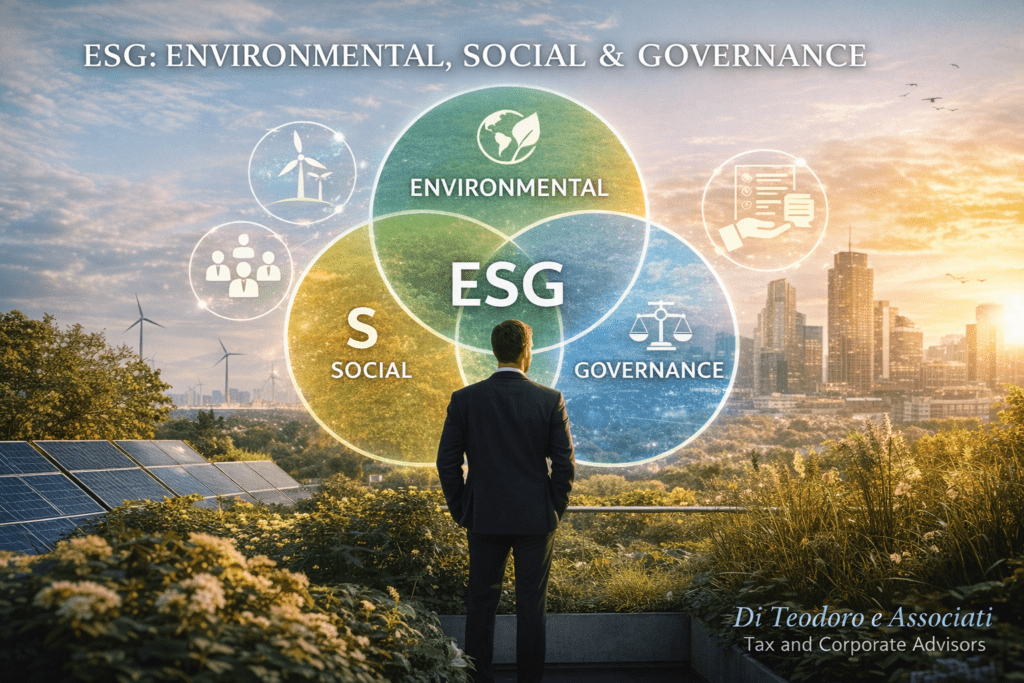
In recent years, sustainability has moved beyond the realm of “values” and has become firmly embedded in economic decision-making. For "banks", in particular, ESG is no longer marketing language: it is a matter of **risk management** and **the resilience of the credit portfolio**. This helps explain why, in the bank–company relationship, requests for information on emissions, transition plans, safety, supply chains, and governance are increasing—even when the company is not formally subject to reporting obligations.
Why are banks so focused on sustainability?
The reason is regulatory and prudential. In Europe, authorities are requiring financial intermediaries to **identify, measure, manage, and monitor ESG risks**, integrating them into processes and resilience plans. The EBA has issued final guidelines on ESG risk management, linking them to CRD requirements and setting organisational and planning obligations over short-, medium-, and long-term horizons. (eba.europa.eu) On the supervisory side, ECB Banking Supervision has set out expectations for banks on managing climate and environmental risks (including self-assessments and action plans required from institutions), making clear that these risks cannot be treated as an “optional extra.” (bankingsupervision.europa.eu)
Put into practical terms: if a bank has to demonstrate that it is managing ESG risks, it needs data and signals from its counterparty (the company). And when the data are missing or inconsistent, the bank tends to “price” that uncertainty.
Not only banks: why stakeholders are also pushing ESG
Relevant stakeholders are not only financial. Sustainability has also become a condition for relationships with:
- corporate customers (supplier qualification, tender requirements, contractual clauses),
- investors and asset managers, also due to transparency obligations on sustainability risks (SFDR), which increases demand for ESG information along the investment chain. (EUR-Lex)
- large companies subject to the CSRD, which must also collect data from their value chain, creating a “cascading” effect on many SME suppliers. (EUR-Lex)
In short: even when there is no direct obligation, the request may come indirectly, because someone upstream (a bank, customer, or investor) has constraints or expectations to meet.
The impacts of stronger ESG compliance
Over time, stronger ESG compliance tends to generate primarily “defensive” and stabilising benefits:
- improved bankability: greater ease in responding to questionnaires, internal ratings, and information covenants; less friction during credit assessment and facility reviews;
- lower perceived risk: consistent data and credible plans make transition risk (regulation, energy, supply chain) and physical risk (weather events, supply disruptions) more manageable;
- greater access to dedicated instruments (e.g., KPI-linked loans or facilities tied to sustainability targets), where the requirement is not “to be perfect,” but to be measurable and verifiable;
- rafforzamento nelle relazioni di filiera: continuità come fornitore qualificato e minori contestazioni contrattuali su requisiti ESG.
The impacts of weaker ESG compliance
When compliance is weak or not documentable, the typical effect is not an immediate “no,” but rather increased friction and a higher cost of uncertainty:
- potentially higher cost of capital or tighter terms, because the bank cannot properly assess exposures and vulnerabilities;
- higher risk of commercial exclusion in structured supply chains (supplier audits, traceability requirements, clauses on rights and safety);
- reputational and legal risk linked to unsupported claims (greenwashing) or supply-chain issues that emerge ex post, with consequences for litigation and crisis management;
- loss of time and higher internal costs: ad hoc responses, reconstructed data, inconsistencies across functions, up to delays or blocks in tenders, contract renewals, or credit processes.
In conclusion
Sustainability is “sensitive” for banks and stakeholders because it has become a proxy for two very concrete factors: risk and management capability. This is why, today, the difference between stronger and weaker ESG compliance is reflected not only in reporting, but in the quality of economic relationships: access to credit, supply-chain stability, information reliability, and operational resilience.
DTA